
Books and reading have always been a big part of our babaà world. In our new series we ask friends of babaà about their reading style, favourite books, and emotional connection to the written word.
For the sixth in our series we asked our favourite bookseller Jorge Domingo to share his love for books, and he answers from our favourite bookstore in Madrid, Desperate Literature, where he actually works while studying film and theater. Thank you Jorge.
how do you organize your books?
this is a tricky question for a bookseller. in the shop, I like how second hand and new books -or even books in different languages- are shelved together, prioritizing interesting titles and editions over the publishing house. I really don’t like those bookshops where books are arranged by publishing house or colour, it makes it look like an online catalogue and misses the curation bit, which to me is the most enjoyable task. at home I do the same but without the need to alphabetize by author that the shop requires. I tend to group books by the connections I’ve made between them -either because I read them in a row or because they have a similar style. there’s a section for film -in a very broad sense- with books by artaud, plato, jarman, benjamin or val del omar. there’s an illustrated album section with comic books by clowes, mcguire and children albums by crowther and sfar. and then there’s my favourite section, in a shelve above my bed, with my all time favourites, the ones that make me feel at home.
what are you going to read next?
last summer I read wuthering heights and I really liked how dark and perverse it is, and this sense of getting to know the characters for generations and almost being able to predict their behaviour. so I’ve decided that I’m going to read a classic novel -at least- every year. I think now it’s the turn for clarin’s la regenta.
if you had to pick- do you prefer reading emotional or intellectual books?
I don’t know if they’re so differentiated… I’ve read theory essays that have made my heart beat in excitement and recognition -like andrea soto calderon’s or remedios zafra’s- and passionate novels –wuthering heights is a good example- that left a trace of despair and made me reflect on evil and the boundaries between desire and death drive. writers like simone weil or maria zambrano, or even albert camus, share this style that is reflective and poetic at the same time. this being said, if I had to choose I’d say emotional.
the last book that made you laugh?
it must have been tonterías by juanpe sánchez lópez, a very tender and apparently simple in style book of poetry that hides beautiful images and playful texts that, as in mariano blatt’s poems, sometimes read like jokes, with a final punchline and all. chilean author alejandro zambra -who, by the way, has been a judge for the desperate literature prize- is also one of those writers that get you smiling as you turn the page. or raymond queneau, one of my favourite writers.
describe your ideal reading environment. show us!
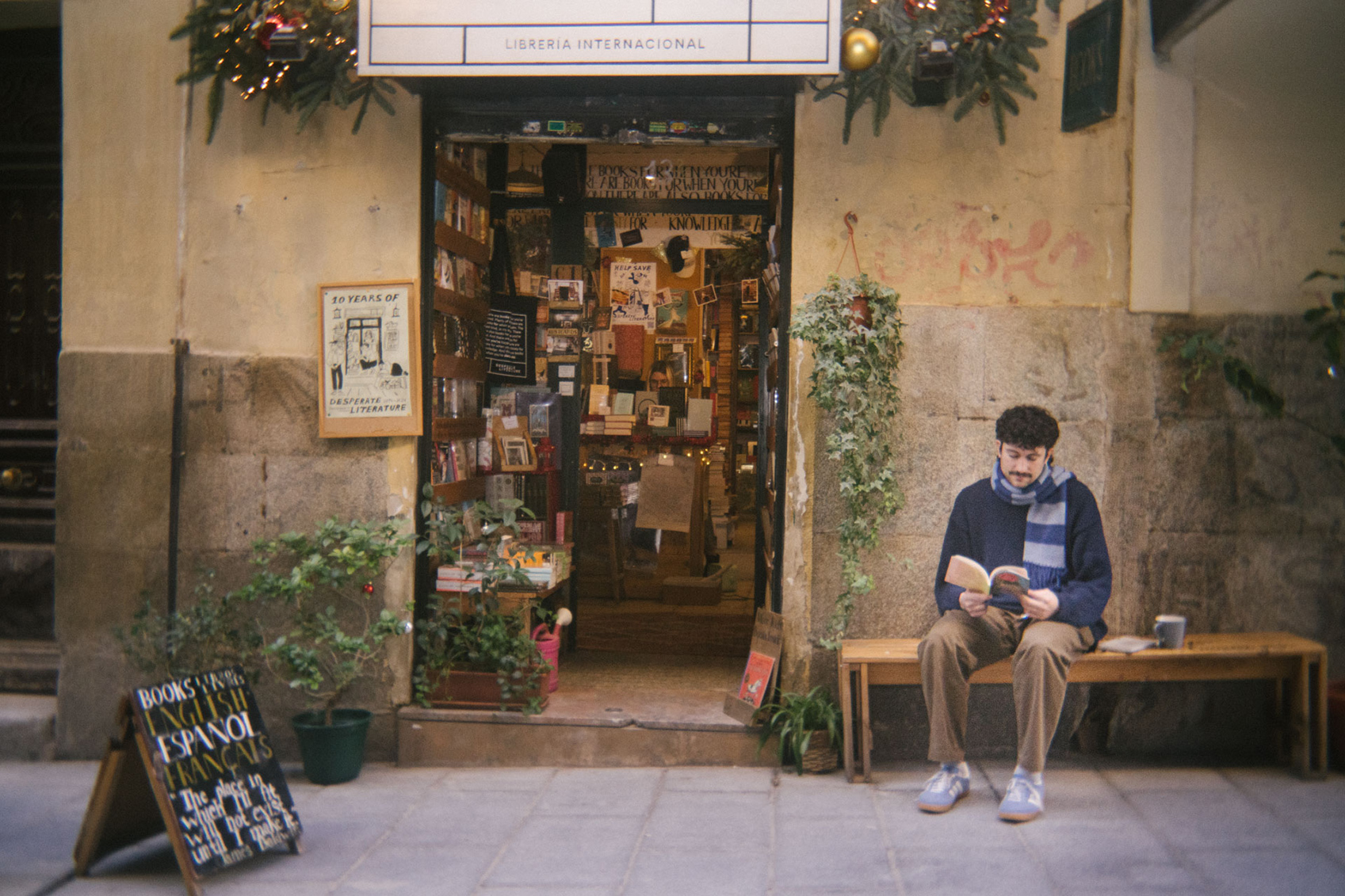
this is me reading at desperate literature, the bookshop in madrid where I’m a bookseller. it’s a perfect example of my ideal reading environment: surrounded by books, cozy and warm, peaceful and silent and well lit. and with a warm beverage, black tea with milk in this case. now, you have to know that this is a fake. this has never and probably will never happen. people tend to think that booksellers spend their shifts reading and leafing through books -I used to think so as well- but it has never happened to me. everytime I open a book in the till the doorbell sounds and a customer comes in.
what was your relationship to books growing up?
both my parents were teachers so there were lots of children books at home. also my uncle philip brought lots of illustrated albums from the uk among which I remember where the wild things are, quentin blake’s and dr. seuss’s. I remember my parents singing a lot to me as well, nursery rhymes and poems like romance del conde olinos, el lagarto está llorando and lots of gloria fuertes. I also remember leafing through a huge edition of quino’s todo mafalda that I loved, so heavy that it could only be read lying on the living room’s carpet. as a teenager I enjoyed fantasy a lot -I loved cornelia funke’s inkheart and the thief lord– until, thanks to a wonderful literature teacher, I discovered the lost generation, specifically steinbeck’s the grapes of wrath.
is there a certain emotion you’re looking for when picking out what to read?
not really, I think it’s more of an atmosphere rather than an emotion. and it depends on the moment. but I lately prefer unclear narrators, untrustworthy voices that contradict themselves and don’t necessarily follow a lineal stream of narration. in this sense I’m a fool for clarice lispector, sara gallardo and bernard marie koltés. I think there’s something very poetic in how they jump from sentence to sentence and from one thought or image to the other. something poetic, mysterious, open and very enjoyable.
you have 12 uninterrupted hours to read right now, what do you reach for?
I’m tempted to say derek jarman’s modern nature or a thick book of poetry like berta garcía faet’s corazonada or leopoldo maría panero’s complete works, all books I feel that rouse an intense and intimate connection with the reader. although maybe their formats -journals and poetry collections- feel more appropriate for a spaced, bit-by-bit kind of reading. then, a longer novel like nabokov’s ada or ardor, which I’m looking forward to reading, or a comic book can be better choices. I’ve got it: I choose building stories, by chris ware.
show us a stack of books you have laying around in a photo.
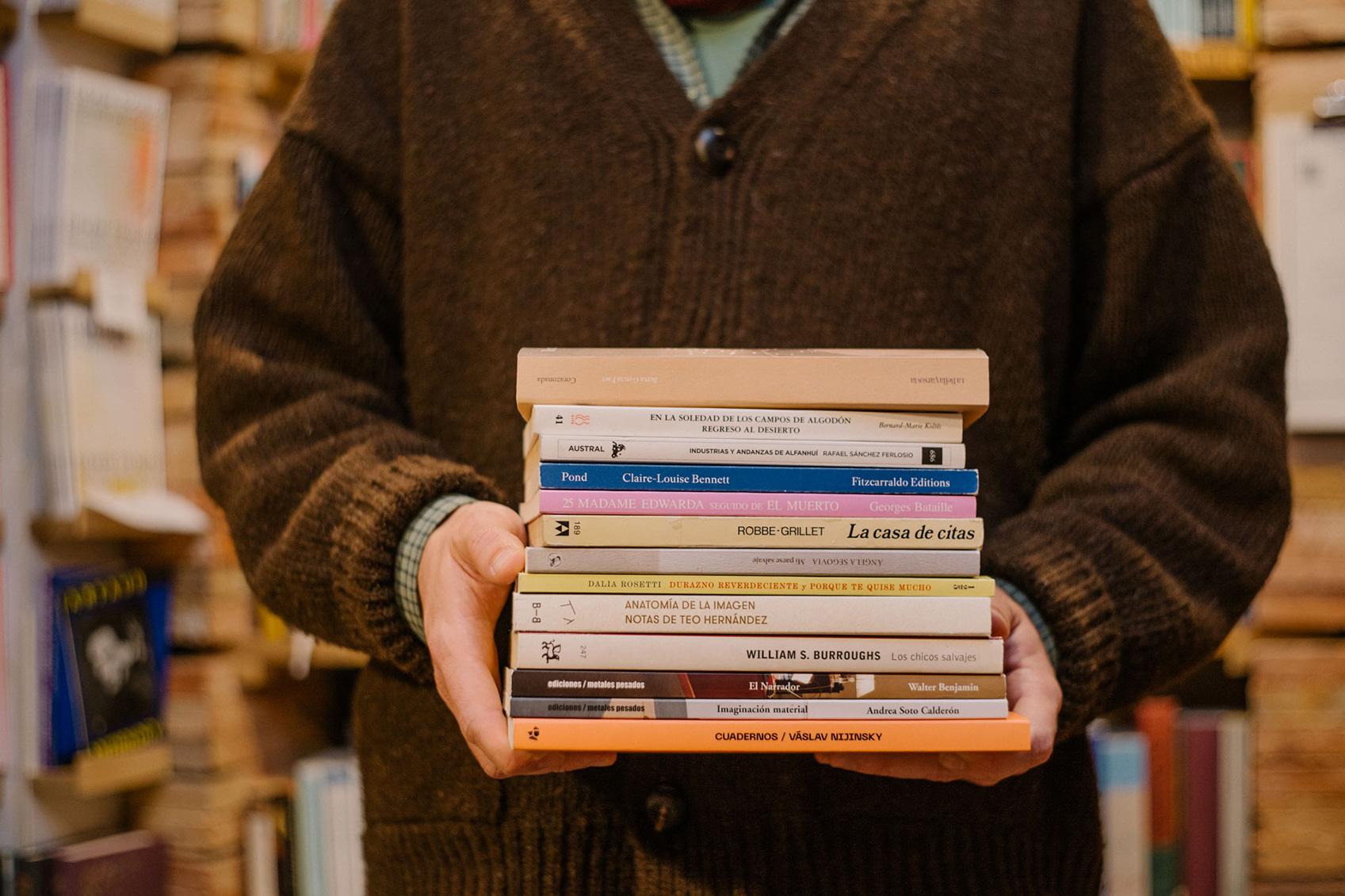
what’s the book that has made the biggest impression on you in the last 5 years?
it has to be bataille’s story of the eye. I remember having to go back to read a paragraph several times. the images he builds up are so unbelievable and confusing that one has to take a while to imagine what’s being described and, what’s more interesting, to evaluate what that is making one feel ¿is it fear, is it arousal, is it disgust?
you walk into a bookstore… what section do you go to first? how come?
the truth is that the best sections tend to be where the children’s books are. like in desperate literature’s children’s corner, they tend to be very cozy spaces, with places to sit and browse calmly. I always have a look at the second hand section if there is one too, because it tends to be where hidden treasures can be found. when I used to come to desperate literature as a customer the first section I checked was the drama section: most of the books there were second hand editions of texts that I had never seen translated into spanish, and it was also a way for me to discover new titles and authors.I just remembered a bookshop I went to in palermo, sicily, built inside of the belltower of the church beside it. the shelves where quite tall and you had to use a ladder to climb to the top. well, it’s erotica section was built behind a little door that could only be accessed from the top of one of this shelves. the bookseller claimed that there was a hole in the wall through which one could spy the priests from the church next door. he never let me in to confirm.
is there a sentiment that you’ve read that has changed you as a person? what was it?
I’m sure that the way I think of and feel about friendship would not be the same if I hadn’t read steinbeck’s of mice and men as a teenager, more recently, virginia woolf’s gorgeous the waves. in the latter friendship is not only the main topic of the plot but the essence of the way in which this choral novel is conceived, jumping from character to character to weave the most beautiful collective stream of consciousness. it really is breathtaking.
how do you choose what you’ll read next?
there’s something very pleasurable about finding the thread that leads you from one reading to the next one, the pulse that urges you to go on exploring a certain feeling or style, or the need for something completely different, opposed to the previous reading. it can be a title directly mentioned in the text that rouse curiosity, an author from the same group or generation of writers, or even authors that you know were friends -or foes- or a text that you intuitively feels right.
do you take a break between books or dive right in to something new?
I’ve realised that I normally read several books at the same time, but only if they’re different formats. in my bedside table there’s always a novel, a book of poetry and an essay. now, for example I’m reading juan josé saer’s el limonero real (the regal lemmon tree), juanpe sánchez lópez’s tonterías, and andrea soto calderón’s la performatividad de las imágenes. I like to take one or the other depending on how tired I am, for example. and I tend to start thinking of what to read next while before I finish the book I’m reading in each of the genres. then, depending on the impression the book has left on me, I take more or less time to start the next one. it feels like leaving space for the traces of the last one to settle.
if you’re not feeling a book, will you finish it?
it has taken me a lot effort to learn to stop reading a book if I’m not liking it. my fear was that I felt I would never be as close to the end as in that moment, and that I wouldn’t have the patience to read again the part I had already read. but over time I’ve learnt that it’s good to insist with a book -sometimes it’s a matter of style, and that part that you’re not enjoying may be the counterpoint of what’s to come- but not to get stuck trying to read something you’re definitely not enjoying. and who knows, maybe when you go back to it, if you ever do, you’ll be in a different mood or moment in your life that will make you enjoy things you previously didn’t.
how have your reading tastes changed over time?
whenever I think my tastes have settled I discover something new or someone recommends an author I didn’t know and curiosity is stronger. I think that literature is a way of expanding ourselves and our experience of the world. so the more varied the better. it’s boring to stick to a closed style and reject the rest, there’s always something interesting that might surprise you. I was obsessed with existentialists to a point in which I got a bit bored and had an urge for playful books like raymond queneau’s, till I missed reading spanish authors after a period in which a read lots of translated texts, so went back to re-discover texts I had had to read in highschool and hadn’t particularly enjoyed. it’s thrilling to delve into this changes in taste.
photos by andrea dorantes