
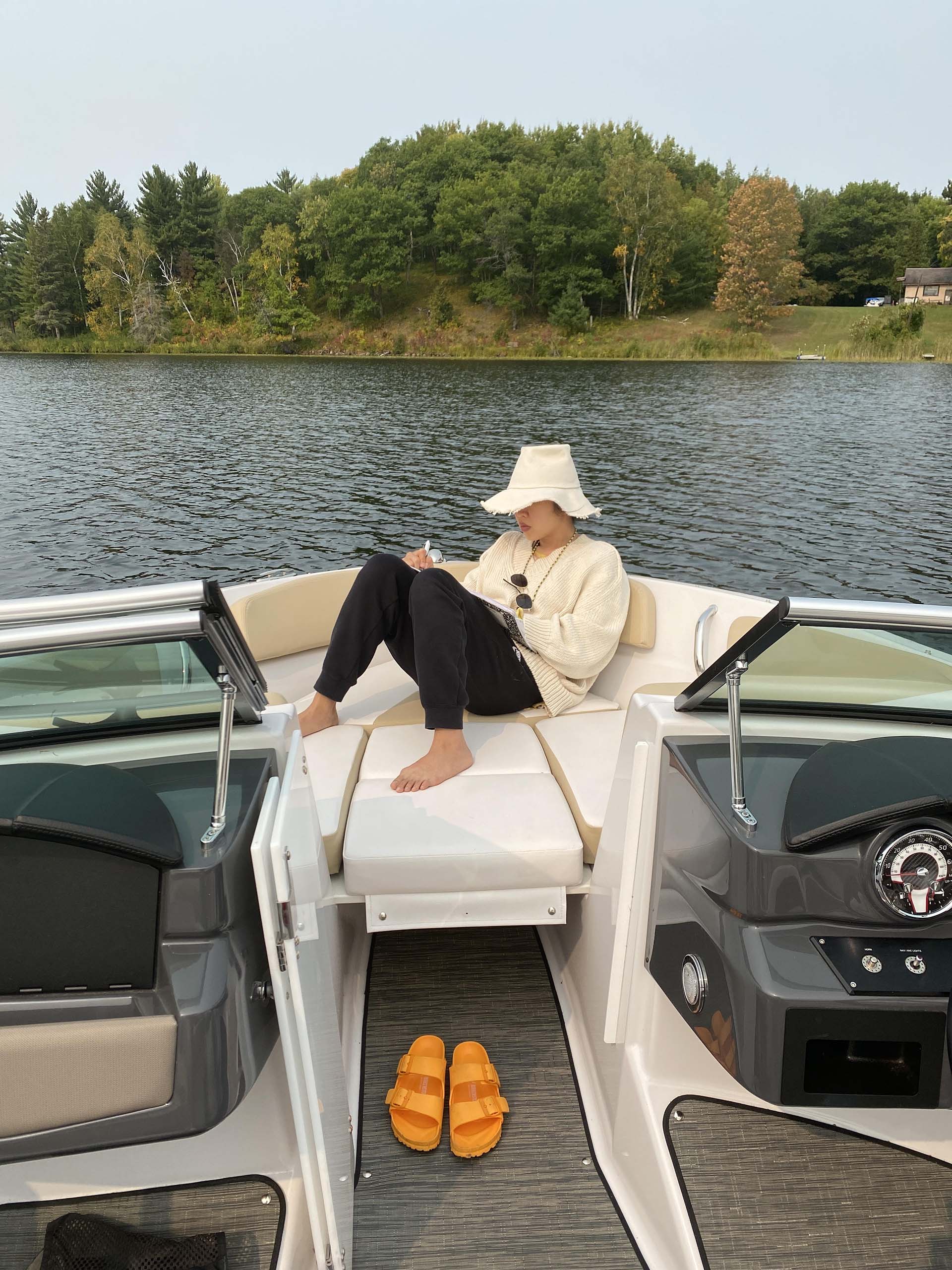


Books and reading have always been a big part of our babaà world. In our new series we ask friends of babaà about their reading style, favourite books, and emotional connection to the written word.
For our third in the series we talk with Natalie So, a writer whose insatiable curiosity for people and stories has taken her all around the world, from the Middle East to the favelas of Rio de Janeiro. It’s no wonder that she’s felt similarly transported by books from a young age. You can learn more about Natalie’s work here.
what was your relationship to books growing up?
Intense, dynamic, vital.
My mom started taking me to the library every weekend when I was two or three, where she’d teach me to read using phonics books, even though English was her second language. I’m so grateful. By the time I was five, I would lock myself up in my room for hours at a time and read up to 20 books in a single sitting. I was a maniac. I read everywhere—at restaurants under the table, in the car until I was nauseated, beneath the covers, for which I was often scolded and told that I would ruin my eyes (I am indeed very and unfortunately near-sighted).
I was ravenous for books because it was the way I learned about the world beyond my world. Books were transportive, they held a key to somewhere else. They were comforting, provocative, illicit. I would steal Sweet Valley high books from the school library because my mom wouldn’t let me read them. I learned more about sex from reading Judy Blume’s Summer Sisters than from sex ed—it was the first adult book I checked out from the library. Early on it became clear to me how much power books contained—to expand and change your mind, to give you access to people and secrets and places that you weren’t supposed to know.
The only thing I’m sad about is that so many of the books I read were written by and featured only white people—I wish that hadn’t been the case.
if you had to pick—do you prefer reading emotional or intellectual books?
The two aren’t mutually exclusive and are in fact intensely connected for me. My ideal book is both intellectual and emotional. Elena Ferrante’s Neapolitan series and Hua Hsu’s incredible memoir Stay True are perfect examples of books that are both deeply intellectual and emotional at the same time (and they happen to be some of my favorites).
is there a certain emotion you’re looking for when picking out what to read?
This is my favorite question and one I think about all the time.
In hierarchical order, with examples, because I love categorizing things:
* quiet heartbreak (not necessarily literal): Cold Enough for Snow by Jessica Au and Western Lane by Chetna Maroo, Kazuo Ishiguro’s A Pale View of Hills, Gilead by Marilynne Robinson, Annie Proulx’s short stories.
This is a feeling that I also look for in movies (and maybe all kinds of art), and if you’ve watched any of the following films then you’ll know exactly the feeling I mean: Close (Dhont)a, Still Walking (Koreeda), Mustang (Ergüven), House of Hummingbird (Kim), Poetry (Lee), Water Lilies (Sciamma).
* a precise, but complex emotional intensity: all Elena Ferrante, all Deborah Levy, The Mars Room by Rachel Kushner. For this reason I really love short stories, which often accomplishes this most efficiently.
* a sense of wonder (at language and of the world), a sense of the absurdity and strangeness (of language and of the world): all Marilynne Robinson, Y/N by Esther Yi , 10:04 (and really, all Ben Lerner, whose work I love), The God of Small Things by Arundhati Roy, many books in translation (by virtue of the nature of translation, which often makes language an alien thing, a feeling I love).
I also generally enjoy books that feel a little beyond my understanding and grasp. I like a challenge.
what are the books that have made the biggest impression on you in the last 5 years?
Minor Feelings by Cathy Park Hong and Just Us by Claudia Rankine. Both opened up my mind to aspects of race and society that I’d previously had difficulty understanding or recognizing. I think about those two books all the time. They should be required reading for everybody.
you have 12 uninterrupted hours to read right now, what do you reach for?
First, a collection of short stories cover to cover. I rarely get to do this and there’s a certain pleasure in reading stories together, rather than one at a time. I’d probably choose a collection by Annie Proulx, Yiyun Li, or Jean Stafford.
Next, a Patrick Radden Keefe book. He’s one of the best working non-fiction writers, in my opinion, and can make true stories sound like fiction—a skill I envy. Maybe Rogues or Empire of Pain, which I haven’t read. Or I’d re-read Say Nothing or The Snakehead, both of which are fantastic. I love getting lost in these.
And finally, a novel from a very particular list of mine. I once solicited friends for their most compulsively readable, viscerally pleasurable (on a language and plot level), propulsive, and awakening books, and I have compiled all their answers. I’m trying to make my way through them. (For me, these types of books would include the Neapolitan novels; everything by Edward St. Aubyn, Ben Lerner, and Susan Choi; Severance by Ling Ma, and Vladimir by Julia May Jonas, to name a handful.)
the last book that made you laugh?
Big Swiss by Jen Beagin. But I’d be remiss not to mention a book I read years ago that made me laugh the MOST: Priestdaddy by Patricia Lockwood.
you walk into a bookstore…what section do you go to first? how come?
The bookseller recommendations shelf. I love reading the little note cards explaining why a particular person loved a book. That kind of context is helpful and meaningful to me, and I’m more interested in someone’s personal connection to a book—especially if that person loves books like I do—than bestsellers or celebrity memoirs (it’s all marketing and hype!).
How has your reading habits/tastes changed since becoming a mother?
While I was pregnant, it felt as though my brain shut off—which in retrospect makes sense: So much energy was being used to create a human inside my body. As a result, I could barely read (also a consequence of the pandemic, I think), but I did read a few books on motherhood, which I probably wouldn’t have done before I was pregnant. The books I appreciate most in this vein are unafraid to wrestle with the complexities of parenting: Rachel Cusk’s A Life’s Work, Heidi Julavits Directions to Myself, Essential Labor by Angela Garbes. I’m also looking forward to reading Olga Ravn’s My Work. I found Garbes’ book Like a Mother to be very helpful in terms of understanding pregnancy and labor.
After giving birth, my appetite for books has increased dramatically. Reading feels, more than ever, like an arena where I can expand and explore myself outside of my identity of being a mother, nurturer, caretaker. Motherhood is such an animalistic, body-centered practice for me that when I have time to spend time alone in my mind—the way reading and writing allows me to do—it feels like such an indulgence, both energizing and escapist in the best way.
what are your favorite books you like to read to your one-year-old son?
As much as possible I try to “read” books to my son that I’m also interested in. A lot of these are the more visual books I own. I especially love the LOST III collection of photo books by KGP/Monolith and the TIS Books multi-artist series, all of which are slim paperbacks that are easy to hold and not too precious. In the first year of my son’s life, we flipped through Eclipse by Rose Marie Cromwell a lot—it’s a portrait of matrescence (“the physical, psychological, and spiritual changes of motherhood”), very relevant to my own state of being at the time. Other books in these series that I have a particular affinity for: Montreal: Tess Roby, Bryn Mawr: Alina van Ryzin, and The Potter Become the Pot by Will Matsuda. Siglio Press is another great publisher of visual books driven by a feminist ethos—What Is Now Known Was Only Once Imagined: An (Auto)biography of Niki Saint Phalle is fantastic fodder for kids. I also recently purchased A Dark, A Light, A Bright: The Designs of Dorothy Liebes, a book of Liebes’ weavings that I’m excited to share with him as well.
In terms of “conventional” kids’ books, I lean towards anything that will teach my son about female artists or non-Western cultures. The Phaidon kids art books are great, as is A Life Made by Hand: The Story of Ruth Asawa, published by Chronicle Books. My son is particularly drawn to this book called ABCs for American Born Chinese, which illustrates the alphabet using Chinese American foods. We also like going to Blackbird Books in San Francisco on the weekends and picking out childrens’ books there.
what are you going to read next?
Real Americans, by my dear friend Rachel Khong. Rachel was generous enough to give me a galley of her novel, which comes out next spring. I first met Rachel when she was starting to write this book seven years ago, so I’ve literally been waiting to read it for years. It’s a multigenerational epic about the complexities of family, genetics, and choice, and Rachel is one of my most brilliant, thoughtful friends, so I know it’s going to be amazing.
I also have a whole slew of books in translation that I’m looking forward to reading: The Wedding Party by Liu Xinwu, Whisper by Chang Yu-Ko, Another Person by Kang Hwagil, and Flowers by Mold by Ha Seong Nan. Two short story collections on my nightstand: Wednesday’s Child by Yiyun Li and Open Up by Thomas Morris. In the world of nonfiction: How to Stand Up to a Dictator by Maria Ressa and Altered Traits by Daniel Goleman and Richard Davidson. And maybe, just for fun, Going Infinite by Michael Lewis (I love a juicy tech world story).